
Source: Flickr
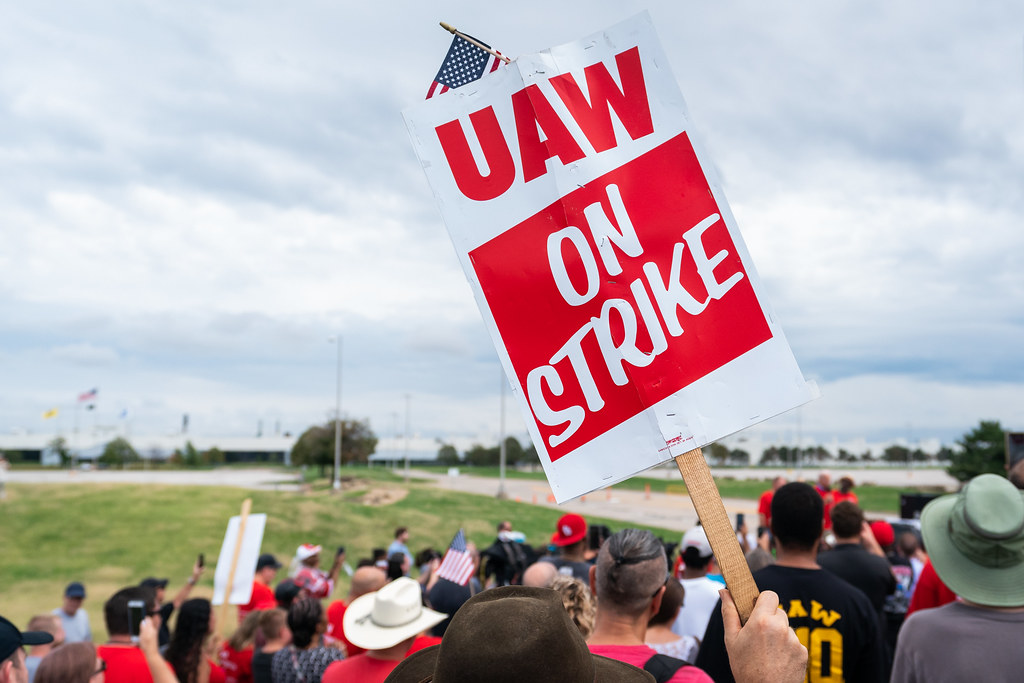
In September, the United Auto Workers conducted a historic strike targeting the three largest U.S. automakers: Stellantis, General Motors, and Ford.
By Mriganka Maroo
Edited by Aaron Jacobowitz
This year has been marked by multiple labor union strikes and their massive achievements. Hollywood was brought to a screeching halt for months when the Writers’ Guild of America went on strike for improved royalty payments and protection against AI-written scripts; health care company Kaiser Permanente faced its biggest ever strike and agreed to increased pay for its workers; UPS is another giant corporation that made a new deal with its union to avoid its drivers striking. Currently, the United Auto Workers Union, or the U.A.W., is executing its most strategic and powerful strike against carmakers.

Source: Bloomberg
While the U.A.W. represents workers across multiple industries, a significant proportion of its members work for the ‘Big 3’ in auto manufacturing; this refers to the largest carmakers in the U.S., which are Ford, General Motors (GM), and Stellantis, which is the parent company of Jeep and Chrysler. The U.A.W. was officially formed in 1935, after the first-ever recorded labor march against Ford in 1932. Since then, the U.A.W. has carried out many strikes, marches, and protests against these carmakers and has successfully bargained with employers for their members, ensuring increases in pay, job security, pensions, and health benefits. The 21st century has seen two major moves from the U.A.W.: a strike in 2007 for job security in the face of the Global Recession, which yielded scarce results due to decreasing union membership and carmakers facing financial struggles outside of labor costs; and a strike in 2019 for pay, job security, and improved benefits, which resulted in pay increases and more investments in certain plants—a sign of job security and growing opportunities.
Most recently, the U.A.W. organized a strike that impacted three assembly plants in three different states, one belonging to each carmaker. Overall, 45,000 workers have been striking since mid-September. This move came after the carmakers and the U.A.W. could not agree on terms for their new deals, which would impact 146,000 workers. One of the primary demands was increased pay. Full-time workers earned between $18 to $32 an hour, while, at the same time, each Big 3 CEO took home over $20 million in 2022, with the GM CEO’s compensation growing by 34% and Ford’s CEO’s increasing by 21% from 2019 to 2022. In addition, workers also sought an end to the tiered employment system, wherein newer workers get poorer pay and worse benefits. Since the carmakers were unable to come to a satisfactory deal, the U.A.W. took matters into their own hands.
What makes this strike different from the previous ones that the U.A.W. has organized? Their strategy has generally been to take action against one carmaker and leverage that to renegotiate their position with the other two carmakers. For instance, the aforementioned strikes in 2007 and 2019 mainly targeted GM. In a more notable example, in 1950, a strike against what was then Chrysler cost the company $1 billion in sales; eager to avoid a similar fate, GM negotiated a new contract, which was considered a “landmark agreement in U.S. labor relations post-war.” However, the ongoing strike is unique and considered historic, as for the first time, the U.A.W. is simultaneously striking against all three carmakers. This was a strategic move, as they wanted to keep all three-companies off-balance and constantly guessing who would be impacted most. Complementing this psychological tactic was U.A.W.’s strategic selection of targets. The U.A.W. deliberately chose assembly plants that supplied products crucial to the downstream manufacturing process. Such disruption would create bottlenecks and reduce production—even if laborers at those plants were still working—thus enabling the U.A.W. to have fewer members picketing while still being able to halt production significantly. This yielded another benefit: with fewer workers striking, they could spend less out of their own endowments to pay striking workers’ benefits and thereby preserve their ‘strike fund.’
Furthermore, they did not target the companies’ factories producing the vehicles that brought in the most money—i.e., the SUVs and large pickup trucks. This strategic move preserved a ‘hidden arsenal’ and a weapon they could leverage if the existing negotiation procedures failed. Finally, U.A.W. publicized internal documents, such as contract specifics, current updates, and opinions, broadcasting them on social media to exert greater pressure on the already scrambling automakers.
The U.A.W.’s new tactics have cost the automakers heavily: GM lost $200 million per week in profits, and it cost Ford $1.3 billion in pre-tax profits. Such a heavy toll yielded some of the most successful strike results ever. Pay increases factor in the rise of the cost-of-living, base wages increased from $18 to $30, and the top wage will increase from $32 to $42 by the end of 2028. They have also negotiated many other benefits, including a 3.6% increase in 401(k) contribution, a $1,500 new vehicle voucher, a $5,000 ratification bonus, and job security, manifested in such avenues as an $8.1 million investment from Ford and the right to strike for closing plants. Indeed, this is a historic win for the U.A.W. and unions everywhere. Further, this has put pressure on foreign firms operating in the U.S. as well, with Toyota increasing wages by 9%. After this round of contract renewals, the U.A.W. plans on organizing and unionizing workers for other big carmakers—including Toyota, Volkswagen, and the notoriously anti-union Tesla—along with workers who are generally excluded from these union benefits, such as temporary workers, and workers who belong to the Big 3’s joint venture firms.

Source: Bloomberg
While the victory was historic, it has significant implications with respect to factors like production costs and the strength of unions. Such massive increases will exacerbate production costs for these companies. Ford’s labor cost is anticipated to increase by between $850 to $900 per vehicle, weakening their competitiveness against companies like Tesla that don’t have unionized workers. Some workers suffered as a result of the strikes due to the strategic targeting of the strikes, with many workers at non-striking plants laid off. A union is only as strong as the solidarity felt by all its members, and any faltering can undermine its overall progress. Further, such strikes are only possible when there is a strong labor market and workers can exert their bargaining power. In times of high unemployment and economic downturn, in general, unions lose their bargaining strength. As economists forecast recession in the coming months of 2024, it is worth wondering how this might affect negotiations, should they continue. Earlier in September, it was predicted that a six-week strike could result in a 2% to 3% decline in GDP. The ensuing overall economic impact would be a net loss of $5.6 billion, with $2.1 billion cost borne by consumers alone. Thus, there are important considerations on both sides. However, it is important to acknowledge the positive outcomes: This movement has monumentally improved outcomes for thousands of workers, and has established a strong precedent for many other unions in other industries, strengthening labor outcomes across the country.

Source: Bloomberg



 The Economics Review
Leave a comment