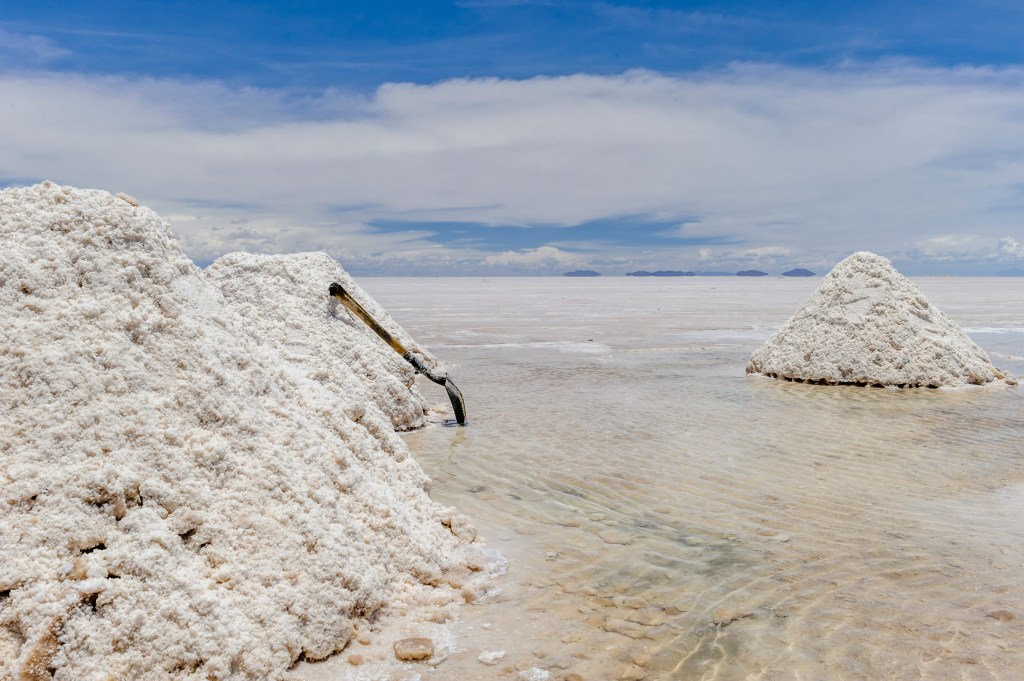
Image source: Alexander Schimmeck
As lithium becomes more relevant in a global economy that increasingly relies on renewable energy sources, political and economic challenges that govern the status of its procurement have emerged. Investment patterns offer insight into the forces governments and organizations are exerting to mold the mineral’s global supply.
By Nicolas Garza Perez Obregon
Edited by Haanbi Kim
Investment in alternative energy technologies–and, consequentially, fossil fuel divestment–is a current fixture in the minds of policymakers and business leaders alike. Though seemingly novel, these ideas have been foremost concerns for energy corporations for decades. More than 50 years ago, Exxon’s research division, driven by statistical models that predicted a global decline in the demand for oil at the turn of the century, made significant strides in the field. Such efforts culminated in the development of the lithium-ion battery, which allowed energy to be stored at a much greater density compared to existing battery technologies and enabled scalable yet affordable battery systems. Although this invention quickly spread to other realms, the persistent demand for oil and its derivatives throughout the following decades did not immediately catapult Exxon’s invention to the stardom of energy storage promised by their initial predictions of peak oil demand. Nevertheless, lithium-ion batteries are becoming ubiquitous as alternative energy sources become increasingly significant in the global energy supply. This technology is responsible for the efficient energy storage that enables many of the devices that herald a future less dependent on fossil fuels, from electric cars to arrays of solar cells. Yet, similarly to oil, lithium supply dynamics are intertwined with geopolitical and economic narratives that cast doubt on the outlook for the increasingly relevant compound.
Akin to petroleum, the differing geological conditions of each lithium deposit directly impact both the physical and financial feasibility of its extraction. Operations that focus on solidified mineral deposits, where lithium is mined from surrounding rock like those found in Australia, carry cost structures that are approximately 45% lower than those where lithium is found in groundwater brines, such as within South America’s Lithium Triangle that spans across Bolivia, Chile and Argentina. However, Australia’s reserves, estimated at 7.3 megatons, are dwarfed by the collective reserves of the Lithium Triangle, which are estimated at 49 megatons. The mineral’s appreciation in recent years motivated the expansion of mining capacity in South America, and recent advances in Direct Lithium Extraction technologies have introduced the promise of significantly lowering the cost of extracting lithium from brine deposits. The technology could potentially lower the necessary investment to establish mining capacity, reducing the cost of extraction and increasing the productivity of mining operations. Given that most of the world’s currently accessible lithium reserves are found in groundwater brine formations, DLE could drastically shift the conditions that presently govern the mineral’s supply. Forecasts for DLE’s implementation predict an 8% increase in the global raw supply of lithium through this technology.

Despite the advancements in mining technologies, lithium-ion batteries remain far from becoming a widespread form of energy storage that rivals petroleum and its derivatives. A main challenge for lithium-based forms of energy storage is the global insufficiency of lithium refining capacity. Moreover, current refinement facilities are concentrated in China, a net importer of the mineral that controls upwards of 60% of the global lithium refining capacity. Most of the value-adding process concerning lithium occurs in its refining and transformation into batteries beyond the borders of the countries where it is mined, given the scant infrastructure to transform lithium into batteries within the world’s foremost lithium producers. The failure to establish deeper supply chains in lithium-mining countries contributes to the current trend of reprimarization observed throughout developing economies and undermines the strides of industrialization of the twentieth century. These trade dynamics potentially perpetuate a pattern of underinvestment and heighten these nations’ collective dependence on imports of manufactured goods from China and other net exporters.
Without engaging in more comprehensive supply chains that allow for their increased participation in the value-adding process of lithium-based products, the world’s foremost producers of the mineral risk reverting to global exporters of commodities. For Chile, Argentina and Bolivia, this reversion is potentially lodged with negative externalities concerning the detrimental environmental and social effects enabled by extractive forms of foreign investment. Moreover, if these countries limit their participation in the lithium industry to solely the procurement of primary resources, they risk engaging in a “race to the bottom”as they compete to offer fiscal incentives to attract foreign investment. Furthermore, current political volatility in South America, concerning Chile’s repetitive drafting of its constitution and Argentinian President Javier Milei’s libertarian policy proposals could shape the political incentives that will preside over lithium mining operations in South America in the near future. These governments will determine the balance of public and private investment in their respective national lithium industries and consequently the potential efficiency of such mining operations.
Even though the prospects of the lithium economy seem optimistic, demand for the mineral was met with a significant contraction at the onset of 2023. Through its rise and fall, the price of lithium followed the trend of global demand for electric vehicles, whose batteries represent one of the primary use cases for the compound. During 2022, approximately 61% of the global supply of lithium was utilized to produce such batteries. As interest rates increased across the globe, vehicle purchases became unattractive for consumers. The dampening of electric vehicle demand generated surplus inventories of lithium, resulting in lower prices of the raw material. Nevertheless, other uses of the mineral, such as energy storage solutions for solar or wind energy projects, continue to contribute to its demand as investment in renewable energies continues to grow.

Current lithium prices, which have reached levels unseen since 2021, have not wholly dissuaded investment in lithium extraction. In an unexpected continuation of its efforts during the 1970s, Exxon has recently announced its commitment to provide the necessary infrastructure to begin lithium extraction in the Smackover groundwater brine formation as soon as 2027. The deposit spans from Texas to Florida and represents a stronghold of American lithium procurement, especially as global supply leans towards Chinese reliance. Beyond framing this development as a pursuit of American energy sovereignty, Exxon’s plans signal its conviction in lithium as the next dominant energy storage technology.
As continued interest for the mineral prevails in the agendas of the world’s largest economies, the challenge ultimately resides within lithium-producing countries to ensure the establishment of domestic infrastructure that allows them to realize the promises of economic growth that the lithium industry heralds. The concentration of most of the global endowment of lithium across a handful of countries draws parallels with the petroleum industry, potentially introducing a framework to analyze the geopolitical forces that will be exerted throughout the consolidation of lithium supply chains. Yet as larger deposits of lithium become accessible through the emergence of new technologies, the policies that governments, particularly throughout South America, pursue to take advantage of the resource will likely determine the dynamics of global lithium supply and the broader economic relationships that will govern the market in forthcoming decades.





 The Economics Review
Leave a comment